Vai al contenuto principale

#scottbessent

Operación “Paria Económico”: la última carta de Trump en el callejón iraní

Por: Alejandro Marcó del Pont

Seguimos luchando y presionando sin tener q

Altro...

Operación “Paria Económico”: la última carta de Trump en el callejón iraní

Por: Alejandro Marcó del Pont

Seguimos luchando y presionando sin tener que enviar más tropas al terreno (El Tábano Economista)

Cuando una potencia hegemónica no puede lograr sus objetivos máximos en una guerra y, al mismo tiempo, no puede permitirse el costo político de una rendición diplomática explícita, recurre a las sanciones económicas como cortina de humo. La «Operación Paria Económico», anunciada por el secretario del Tesoro Scott Bessent el 25 de agosto de 2026, es menos un arma de destrucción masiva contra Irán y más un escudo político doméstico para enmascarar un punto muerto estratégico, mientras el ciudadano medio subsidia esa ambigüedad con su inflación y su seguridad energética.

En la práctica, esta ofensiva económica representa una admisión tácita de que la opción militar está agotada, que la coalición internacional para un aislamiento total es imposible, y que lo único que queda es mantener una presión simbólica que permita a los políticos actuales sobrevivir a las elecciones de medio término sin tener que explicar por qué el conflicto no resolvió nada. Trump puede seguir diciendo que «seguimos luchando y presionando» sin tener que enviar más tropas al terreno, apelando a una base que apoya la presión máxima, pero se opone abrumadoramente a «botas en el suelo».

Los objetivos originales de la campaña militar estadounidense contra Irán eran ambiciosos y completamente imprecisos, por decir lo menos: asesinato del líder supremo Ali Khamenei, cambio de régimen, finalizar el enriquecimiento de uranio, desmantelamiento nuclear completo, eliminación del arsenal de misiles balísticos y drones, y ahora, como objetivo mínimo viable, la apertura del Estrecho de Ormuz. Casi siete meses después del inicio de la ofensiva en febrero de 2026, ninguno de estos objetivos se ha cumplido. Irán no solo mantiene su régimen intacto, sino que ha demostrado una resiliencia que pocos analistas occidentales anticiparon.

En el libro «Cómo funcionan las sanciones. Irán y el impacto de la guerra económica«, publicado en 2024 por Stanford University Press, se explora la eficacia limitada de las sanciones económicas contra la República Islámica. Aunque la obra tiene una perspectiva que no pudo considerar los cambios recientes en la región por su fecha de aparición, su tesis central se mantiene vigente: Irán lleva 47 años bajo sanciones occidentales y ha desarrollado una «economía de resistencia» sofisticada, con sustitución de importaciones, descentralización de plantas energéticas y un aparato bien aceitado para evadir sanciones petroleras. Como concluyen los autores, las sanciones «no han obligado a Irán a estancarse», sino que, por el contrario, «lo han obligado a innovar, aunque no de maneras que resulten aceptables para Occidente».

Esta experiencia iraní no pasó desapercibida para otros actores globales. Rusia aprendió directamente de la experiencia iraní frente a sanciones. Un análisis de IUVM Press señala que «la experiencia de tres años de Rusia frente a sanciones extensas, comparada con el casi medio siglo de sanciones integrales de Irán, prueba la resiliencia histórica de la nación y gobierno iraní«. Moscú ha adoptado un modelo asimilable al que otros países sancionados pueden seguir, adaptando las lecciones teheraníes a su propio contexto energético y financiero.

A esto se suma el factor chino, que ha advertido explícitamente a Washington que tomará represalias si se amplían las sanciones secundarias contra empresas chinas debido a su cooperación con Irán. China, el mayor importador de petróleo iraní, ha declarado que tomará todas las medidas necesarias contra la «represión del comercio con Teherán». El 7 y el 13 de abril de 2026, el Consejo de Estado de China promulgó dos reglamentos para contrarrestar las sanciones extranjeras: las Disposiciones sobre Seguridad Industrial y de la Cadena de Suministro (Ordenes del Consejo de Estado n.º 834 y 835) y las Disposiciones sobre Jurisdicción Extraterritorial.

Estas normas complementan la autoridad existente de Beijing para tomar represalias contra sanciones extranjeras, incluyendo medidas contra empresas extranjeras que implementen dichas restricciones. La idea es clara: terminar con los tratados de empresas extranjeras que tomen acciones contra China, no permitir contratos o ventas de esas empresas en el mercado chino.

Todo da la impresión de que las sanciones son un juego de sombras, una venta de humo diplomático. El «Día D económico», en el vocabulario hiperbólico de Donald Trump, es tan limitado como hueco. Trump se refirió a la operación como «la operación económica más aplastante jamás emprendida contra país alguno». Sin embargo, casi siete meses después del inicio de la ofensiva estadounidense contra Teherán, la economía iraní, aunque dañada, está lejos de estar descarrilada. Las exportaciones de petróleo iraníes no solo se mantuvieron, sino que se recuperaron a niveles superiores a los del acuerdo nuclear en 2024, sosteniéndose en 2025 y principios de 2026.

Si las palabras ganaran guerras, el conflicto de Donald Trump con Irán habría terminado hace mucho tiempo. Pero lo cierto es que Trump está atrapado en dos trampas que él mismo ha creado: una geopolítica y otra interna. La influencia de Irán sobre el Estrecho de Ormuz y su negativa a ceder le impiden poner fin a la guerra de forma definitiva a un precio militar aceptable. Meses depués del atáque, la opinión generalizada es que es Trump quien necesita urgentemente poner fin a un conflicto que, con las elecciones de mitad de mandato a la vuelta de la esquina, ha hundido su índice de aprobación al 30%, el más bajo desde que asumió la presidencia y uno de los niveles más bajos con los que un líder estadounidense ha afrontado unas elecciones legislativas.

En medio de una campaña electoral donde los republicanos enfrentan riesgos significativos de perder al menos una cámara del Congreso, las sanciones contra Irán ofrecen beneficios políticos y estratégicos limitados para la administración Trump, mientras imponen costos económicos tangibles al ciudadano medio estadounidense. Las sanciones permiten a Trump proyectar acción decisiva sin comprometer tropas terrestres, apelando a votantes que apoyan la presión máxima, pero se oponen a «militares en el terreno» (58% de votantes de Trump se oponen a enviar tropas). Sin embargo, este beneficio es marginal: solo 38% de los estadounidenses apoyan las sanciones, y la guerra en general es vista como «no vale la pena el costo» por 75% de la población.

La administración argumenta que debilitar la economía iraní reduce la capacidad de Teherán para financiar proxies regionales y desarrollar armas nucleares. Sin embargo, 41% de los estadounidenses cree que Trump carece de un plan coherente para Irán, y solo 15% piensa que ha cumplido sus objetivos.

¿Qué le aporta las sanciones realmente al ciudadano medio estadounidense? El shock en los precios de la energía, derivado de la tensión en el Estrecho de Ormuz y las sanciones, ha alterado la trayectoria de la inflación. La gasolina subió alrededor de un 17% desde el inicio del conflicto, impactando directamente el bolsillo de las familias. Los precios de alimentos y fertilizantes permanecen elevados debido a la guerra, afectando el costo de vida que los votantes identifican como su principal preocupación.

Lo que queda claro es que la «Operación Paria Económico» no es una estrategia ofensiva confiada, sino más bien un intento desesperado de enmarcar una derrota y encontrar una salida política a un conflicto que se ha convertido en una trampa electoral para los republicanos. Como señaló Kurt Bardella, ex asistente del Congreso: «Lo que estamos viendo ahora es el completo desmoronamiento de todo lo que Donald Trump, MAGA y los republicanos dijeron que eran. Estaban contra los conflictos interminables en Medio Oriente y comenzaron un conflicto en Medio Oriente sin una estrategia de salida».

El Estrecho de Ormuz marca una contradicción fundamental entre los negocios de las élites y el impacto sobre la población y su voto. El cierre del Estrecho ha creado una economía de guerra que beneficia a actores específicos, mientras perjudica a la sociedad estadounidense promedio. Los datos confirman esta intuición de manera contundente.

https://eltabanoeconomista.wordpress.com/wp-content/uploads/2026/08/petroleoirani.jpg¿Quiénes ganan con el Estrecho cerrado? La lista es ilustrativa. Irán vio sus ingresos petroleros aumentar 37% en marzo de 2026 frente al año anterior. Ahora vende petróleo con 20% de prima sobre precios previos a la guerra, cuando antes vendía con descuento de 10-15 dólares por barril por riesgo de sanciones. Arabia Saudita aumentó sus ingresos petroleros 4,3% a pesar de que las exportaciones cayeron 26%, gracias a que los precios más altos compensaron con creces la reducción de volúmenes. Omán aumentó 26% sus ingresos en marzo de 2026, gracias a sus puertos en el Mar Arábigo como salida alternativa del Estrecho.

Las empresas petroleras estadounidenses de Texas reportaron ganancias extraordinarias. Exxon Mobil informó una ganancia neta de 14.530 millones de dólares entre abril y junio, un incremento interanual del 105%, mientras que sus ingresos ascendieron a 116.020 millones de dólares, un 42% más que en igual período del año anterior. Chevron casi cuadruplicó sus beneficios al registrar una utilidad de 12.070 millones de dólares, un salto del 385% respecto del segundo trimestre de 2025. Sus ingresos crecieron 56% y alcanzaron los 70.060 millones de dólares. La petrolera rusa Rosneft aumentó sus ventas en un mes 14.500 millones de dólares.

El Estrecho cerrado genera una redistribución de riqueza hacia productores petroleros y empresas energéticas, mientras impone costos a los consumidores y a países sin alternativas logísticas. La pregunta política es inevitable: ¿por qué Estados Unidos, bajo una administración que hizo campaña con «America First» y contra guerras interminables, está librando un conflicto que aumenta los precios de la gasolina para sus votantes, beneficia a Irán (su adversario declarado) con ingresos más altos, favorece a Rusia (otro adversario) con precios más elevados y contribuye a las empresas petroleras de Texas que no necesitan ayuda del gobierno?

La respuesta incómoda es que la guerra se ha convertido en su propia justificación. Los actores que se benefician del caos (empresas petroleras, Irán, Rusia) tienen incentivos para mantener la tensión, mientras los perdedores consumidores estadounidenses y mundiales no tienen poder de veto. Como señaló Neil Quilliam de Chatham House: «Ahora que Ormuz ha sido cerrado, puede ser cerrado una y otra vez, y eso plantea una gran amenaza para la economía global».

Esa prima de 40 dólares por barril es una transferencia de riqueza de los consumidores a los productores. Cuánto afectará a Trump esta contradicción en las urnas de noviembre dependerá de cuánto crean los votantes en la «Operación Paria Económico» sin mirar los resultados concretos. Pero la evidencia sugiere que los estadounidenses ya han hecho sus cálculos: 75% considera que la guerra no vale el costo, 41% cree que Trump carece de un plan coherente, y solo 15% piensa que ha cumplido sus objetivos.

La «Operación Paria Económico» es, en última instancia, el reconocimiento de que Estados Unidos ha alcanzado los límites de lo que se puede lograr a través de sanciones y presión económica. El bloqueo mismo, un acto de guerra bajo derecho internacional, es un reconocimiento de que las sanciones empleadas durante décadas «no han cumplido su propósito previsto».

Trump siempre ha tenido múltiples estrategias de salida. Pero como nota el análisis de CNN: «Las guerras tienen una manera de superar los planes de un presidente». La pregunta que queda abierta es si los votantes estadounidenses castigarán en noviembre esta contradicción entre la retórica de «America First» y una guerra que beneficia a adversarios declarados mientras perjudica a las familias estadounidenses. La respuesta, como algunas veces en política, la darán las urnas.

Colaborá con el Tábano Economista

 Si no estás en Argentina

Donaciones El Tábano Economista (PayPal)

https://paypal.me/tabanoeconomista?country.x=AR&locale.x=es_XC

Si estas en Argentina                                          

Ingresá al link para colaborar ($7.000)  https://mpago.la/2DxZ4vC

Ingresá al link para colaborar (10.000) https://mpago.la/34map8M

Ingresá al link para colaborar (13.000) https://mpago.la/34map8M

O una donación voluntaria al siguiente CBU del Banco Provincia de

Buenos Aires: (Alias: SANTA.BANANA.MURO)

#iran #trump #china #americafirst #estrechodeormuz #eeuu #scottbessent #economíaderesistencia #alikhamenei #beijing #chathamhouse #chevron #cnn #congreso #díadeconómico #exxonmobil #iuvmpress #mararábigo #militaresenelterreno #operaciónpariaeconómico #petróleobrent #preciosdelaenergía #repúblicaislámica #rosneft #rusia #stanforduniversitypress #tesoroamericano

0

Caricamento...

0
3

Caricamento...

Wednesday Reads: Trump Chooses Former Mar-a-Lago Pals Over Cabinet and Press

Good Afternoon!!Yesterday, the news broke that Trump used a plane packed

Altro...

Wednesday Reads: Trump Chooses Former Mar-a-Lago Pals Over Cabinet and Press

Good Afternoon!!Yesterday, the news broke that Trump used a plane packed with cabinet members and  journalists as a decoy in order to protect himself from an Iranian assassination threat that emerged when he was in Turkey for the NATO Summit in July.

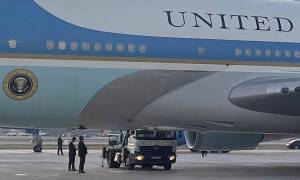
He pretended to board Air Force One with everyone else and then was secretly taken off that plane and moved (hiding in a catering vehicle!) to another one along with some other close advisers, leaving everyone on Air Force One in danger of being shot down by the Iranians.

Trump blames the Secret Service for what happened, but he certainly could have arranged things differently. He could even have had the press plane grounded in Turkey until the other two planes landed in Great Britain. After all, he is (supposedly) the President of the United States! Or has Stephen Miller taken over that role now?

Here’s the latest:

Eric Schmitt and Maggie Haberman at The New York Times: Iran Said to Have Known Details of Trump’s Stay at NATO Summit.

The Iranian threat that prompted President Trump’s secret Air Force One swap last month emerged as he was heading into his last day at the NATO summit in Turkey on July 8.

According to two U.S. officials with knowledge of the threat, U.S. intelligence picked up multiple streams of information. They knew that there was a specific threat of a surface-to-air missile against Air Force One, meaning whichever plane was carrying the president, and that someone in the vicinity of the NATO summit had been spotted with a shoulder-fired missile. And the Iranians knew specifically where Mr. Trump was staying in Ankara, including which floor of the building, the officials said….

The information was deemed sufficiently credible to lead Mr. Trump and senior members of his administration to engage in an extraordinary decoy effort to get him out of Turkey. He boarded the older Air Force One in front of the cameras, which he had announced he would be taking “for old time’s sake,” before sneaking off in an airport catering container and taking a military jet out of the country.

Eric Schmitt, Maggie Haberman, Aric Toler, Jamie Leventhal, Simon Ducroquet, and Yuliya Parshina-Kottas at The New York Times (gift article): A Catering Truck and a Decoy Plane: How Trump’s Great Escape Unfolded.

On the final day of the NATO summit in Turkey, Mr. Trump walked up the stairway to the plane that was supposed to carry him on the first leg of his journey home. He briefly waved to the cameras and disappeared inside one of the iconic, baby blue 747s that have served as Air Force One for decades. Then he secretly exited the aircraft, hidden inside a catering container.

Mr. Trump was next taken to a military jet for a clandestine flight out of Turkey. The 747, filled with journalists, White House officials, aides and others, took off despite what was deemed a credible threat from Iran against Air Force One….

Gen. Dan Caine, the chairman of the Joint Chiefs of Staff, was integral to assessing the threat and deciding how to respond. General Caine is no stranger to subterfuge: His last job was Pentagon liaison to the C.I.A., and he helped devise the diversion tactics during Operation Midnight Hammer, when U.S. forces struck Iran’s nuclear sites in June 2025.

https://skydancingblog.com/air-force-one-sits-on-the-tarmac-in-ankara-with-an-airport-catering-container-adjacent-to-the-body-of-the-aircraft-on-july-08-reuters/Air Force One sits on the tarmac in Ankara with an airport catering container adjacent to the body of the aircraft on July 08. (Reuters)

Not everyone who rode on the plane without Mr. Trump was in the dark. Secretary of State Marco Rubio knew about the threat and flew on the old plane after helping to plan the operation to spirit the president out of Turkey, according to two U.S. officials. They spoke on the condition of anonymity to discuss a sensitive topic.

Other senior officials who traveled on the plane without the president included Treasury Secretary Scott Bessent; Steven Cheung, the White House communications director; and Stephen Miller, Mr. Trump’s deputy chief of staff; as well as several other White House staff, according to a senior U.S. official. It was not clear whether they all knew about the threat.

Whether or not the passengers on the plane that Mr. Trump left behind knew about the threat, they were exposed to risks that the Secret Service deemed too great for the president to face.

Trump claims he had nothing to do with these decisions.

On Tuesday evening, in his first public comments about the secret evacuation, Mr. Trump said the decision was not his.

“It’s really just up to Secret Service,” he told reporters after returning from Ohio. “I just follow what they like to do. So I go by Secret Service and the military. They wanted me to go in a different flight, a different plane for safety.”

Is he the President or not? Since when does the President of the United States take orders from the Secret Service? They advised him of the danger, and he could have insisted on different ways of handling the situation.

The article is very detailed. You can read the whole thing using the gift link.

Dan Lamothe and Cat Zakrzewski at The Washington Post (gift article): Close aides, but no Cabinet officials, joined Trump in airport catering truck.

As President Donald Trump secretly left an Air Force One jet on a catering truck last month in response to a potential Iranian assassination threat in Turkey, he was accompanied by some of his most loyal and longest-serving aides but no Cabinet officials.

Other passengers on the truck included Dan Scavino, the White House deputy chief of staff; Natalie Harp, the president’s executive assistant; and Walt Nauta, the director of Oval Office operations, according to a U.S. official familiar with the operation and corroborating material reviewed by The Washington Post. The official spoke on the condition of anonymity because he was not authorized to talk to the media.

https://skydancingblog.com/a-catering-truck-is-parked-at-air-force-one-on-the-tarmac-at-the-ankara-international-airport-as-the-motorcade-carrying-president-donald-trump-arrives-in-july-alex-brandonap/A catering truck is parked at Air Force One on the tarmac at the Ankara international airport as the motorcade carrying President Donald Trump arrives in July. (Alex BrandonAP)

A few lower-profile aides also were present, but the group did not include Secretary of State Marco Rubio or other officials at the highest level of the government, according to the official and the material. Together, those aboard the catering truck moved under concealment from the legacy Air Force One aircraft to a smaller Air Force C-32A before flying to Britain separately from the White House press corps and senior officials.

The account adds a new level of understanding to a July 8 operation that was first reported by The Post on Monday and has triggered calls from congressional Democrats for an immediate briefing. White House officials withheld the secret move from journalists traveling with the president that day and for more than a month afterward.

Among those on the smaller jet was Defense Secretary Pete Hegseth, who boarded the C-32A using external stairs in a manner that made him look like the senior-most official on the flight, The Post reported Monday.

Scavino, Harp and Nauta were among an inner circle of supporters who worked for Trump at his Mar-a-Lago estate in Florida during the four years between his presidencies, after many other officials who served in the first Trump White House distanced themselves following his two impeachments and multiple criminal investigations.

Other senior administration officials, military personnel, Secret Service agents and journalists remained on the legacy Air Force One plane, which had been deemed too risky for the president’s travel.

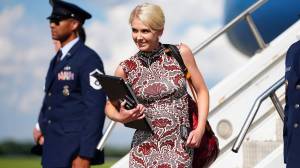
Natalie Harp, the “human printer,” and the woman who left love notes in Trump’s private rooms, according the the book Regime Change, by Maggie Haberman and Jonathan Swan, was seen as more deserving of protection than Trump’s cabinet and closest political advisers!

Ewan Palmer at The Daily Beast: Trump Chooses Blonde Aide Over Stephen Miller in Escape Plot.

Donald Trump made sure he brought his favorite White House aide with him when he escaped from Air Force One to travel in a decoy jet via a catering truck.

Natalie Harp, 35, is never far from the 80-year-old president, and it has emerged that the young blonde aide was among a select group of Trump’s inner circle he took with him as he fled a NATO summit on a military flight because of a credible Iranian assassination threat.

https://skydancingblog.com/natalie-harp2/Natalie Harp

White House Deputy Chief of Staff Dan Scavino, and Walt Nauta, the director of Oval Office operations, also joined Trump inside the catering truck to move to the decoy plane, The Washington Post reported.

Defense Secretary Pete Hegseth boarded the Air Force 32-A via its staircase “in a manner that made him look like the senior-most official aboard the flight,” the Post reported.

Other top officials, including Secretary of State Marco Rubio, top White House aide Stephen Miller and Treasury Secretary Scott Bessent, remained on Air Force One after Trump was made aware of the potential Iranian assassination threat.

Peter Baker at The New York Times (gift article): With Trump Secretly Evacuated, Imperiled Air Force One Became a Flying Decoy.

The threat to Air Force One was seen as so dire that they sneaked President Trump off the jet in a catering container to keep him safe. But the same dire threat did not stop them from then sending Air Force One into the skies anyway with a planeful of senior officials, government employees, reporters and military personnel serving as decoys, some unwittingly.

If the Iranians were trying to shoot down the presidential plane last month, as U.S. officials concluded at the time, then the subterfuge in Ankara, Turkey, that protected the president also may have made targets of dozens of others who flew aboard the jet, including Secretary of State Marco Rubio, Treasury Secretary Scott Bessent and the senior aides Stephen Miller and Steven Cheung.

https://skydancingblog.com/03f7304aee34f3238297c6124fd1676a/Diagram of the plane swap

The government has on rare occasions engaged in sleight of hand to safeguard presidents from possible jeopardy, particularly for journeys to hazardous locations, such as when George W. Bush or Barack Obama flew to Iraq during days of war or when Bill Clinton made a brief visit to Pakistan with its history of terrorism. The Trump team’s ruse in Ankara, however, stands out not only for its misdirection but also for the way it shifted the evident peril to others and was kept secret long after Mr. Trump was out of harm’s way.

“They just didn’t seem to give a second thought to anybody but the president and the few people who were with him,” said Joe Lockhart, who served as White House press secretary to Mr. Clinton during his 2000 trip to Islamabad, the Pakistani capital. “We went out of our way to make sure the maximum number of people, especially civilians, were protected and not human shields. They didn’t even think about it. And to me, that’s the big difference.”

But other veterans of risky White House trips said there were times that extreme measures were justified to protect the president. Joseph W. Hagin, who as a top adviser to Mr. Bush helped organize his war zone trips and later served as Mr. Trump’s deputy White House chief of staff in his first term, said he would not second-guess the decision in Ankara.

“I understand there is concern for those flying on what was assumed to be the primary aircraft,” Mr. Hagin said, “but when you go to work at the White House or travel with the president, you are accepting a not-insignificant degree of risk. Telling everyone what’s up in an operation like this would have obviously jeopardized the president’s safety.”

When Mr. Bush or Mr. Obama brought staff members and reporters with them to war zones, Mr. Hagin added, those were dangerous moments, too. “This was no different than the trips to Iraq and Afghanistan,” he said. “You add up all the risks and figure out the tactics that give you the safest option, regardless of whose toes get stepped on or feelings get hurt.”

The government officials and reporters who traveled with presidents to war zones, of course, knew they were doing so, while those left on Air Force One in Ankara last month were not told of the increased threat. Journalists traveling in the back of the plane were instructed while still on the ground to keep their window shades closed during the July 8 flight from Ankara to Britain, where Mr. Trump landed secretly in another military plane. The president was then sneaked back onto Air Force One so that he could disembark in front of cameras as if he had been onboard all along.

Read more using the gift article, if you’re interested.

Scott Nover writes at the Washington Post: Reporter breaks 26-year silence on briefing that preceded Clinton’s plane swap.

When President Bill Clinton deplaned in Islamabad, Pakistan, the sleight of hand became clear.

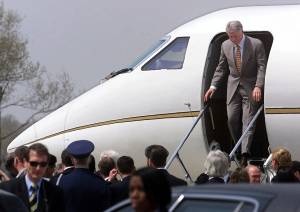
A decoy jet with all of the markings of Air Force One touched down in view of the news media, and a Secret Service agent resembling the president emerged. Then, an unmarked plane landed, and the real president disembarked.

It was March 2000, and Susan Page, a White House reporter covering the trip for USA Today, was one of a small group of people who knew about the ruse.

https://skydancingblog.com/president-bill-clinton-disembarks-from-an-unmarked-jet-in-islamabad-pakistan-in-march-2000-stephen-jaffe-afpgetty-images/President Bill Clinton disembarks from an unmarked jet in Islamabad, Pakistan, in March 2000. Stephen Jaffe AFP,Getty Images

Before the India-to-Pakistan flight, White House officials called Page, then the White House Correspondents’ Association president, and summoned her for an off-the-record conversation. There, White House press and security officials explained the operation, informing her of the president’s location and safety measures in place for journalists on the trip, Page said in messages with The Washington Post.

“They told me about the extraordinary security procedures being taken because of the dangers in flying there, including use of the decoy plane,” she said. “Of course, the dangers threatened the journalists covering the trip as well as President Clinton.”

Page’s briefing, which has not been previously reported, meant at least one journalist in the traveling press corps knew the president would not be aboard Air Force One.

More than 25 years later, the White House faced a similar security dilemma — but handled the press very differently.

Historian Garrett Graff wrote about this episode today. His article is too long to excerpt well, but if you want more on this topic, I recommend reading what he has to say: The Five Scandals Within the “Air Force One” Scandal.Here’s the introduction:

I sometimes believe that the Trump administration’s parade of horribles has left me unable to be surprised any more, but I gasped Monday evening at news that President Trump had been secretly snuck out of the NATO summit in Turkey last month due to an Iranian threat.

That departure in early July had generated a lot of speculation and coverage at the time because something weird was clearly going on — President Trump had, with much fanfare, arrived in Turkey aboard his newly painted presidential jet, gifted by Qatar, and then, with much less explanation, departed Turkey aboard one of the older blue-and-white 747s that have long served as Air Force One. There had been vague mentions of a possible threat, and how the new Qatari-gifted plane lacked some of the defensive measures of the longstanding presidential plane, which in turn led to a Justice Department leak investigation of the five New York Times reporters who broke that story.

Now, though, the Washington Post has added some fascinating and disturbing new wrinkles: He wasn’t aboard the blue-and-white plane at all when it departed Ankara.

I’ve written extensively about presidential travel, security, and continuity of government over the years — I wrote the literal book on continuity of government, in fact — and in the 24 hours or so since the Washington Post broke the story, have given interviews to outlets as varied as the Post, the Associated Press, and the BBC.

I want to try to break down why, specifically, this decoy Air Force One is so troubling. To me, the secret flight out of Turkey represents a Russian nesting doll of scandal, one that exposes at least five levels of scandal, ranging from foreign influence to corruption to national security compromises to inappropriate geopolitical gambles.

Yes, there is other news, but I think the story is important and deserves the amount of attention that is being paid to it. Of course, we already knew that Trump doesn’t give a shit about the press or their well-being, but apparently, he doesn’t care about most of his cabinet members either. When it comes right down to it, he chooses to save Dan Scavino, his former golf caddy, Walt Nauta, his former body man, and Natalie Harp, the “human printer.” (and more?), and Whiskey Pete Hegseth.

Yes, there is other news. Here are some links to to more interesting stories:

The Washington Post: Trump administration set to spend at least $900 million on White House construction.

Will Bunch at The Philadelphia Inquirer: We need the truth about Trump’s alleged ‘ballroom.’

NOTUS: A Group of Centrist Senators Sees a Window to Overhaul Social Security AARP is already lobbying against the bipartisan effort.

NBC News: David Crowley pulls off upset over Francesca Hong in Wisconsin’s Democratic primary for governor.

The Guardian: Trump ally loses, mixed results for progressives: takeaways from primaries in Minnesota, Wisconsin and beyond.

AP News: Earthquake response strains Colombia’s new government and rescuers as they race against the clock.

The 19th: Massachusetts expands abortion access to any point during pregnancy.

WBUR: Signing expanded abortion law, Gov. Healey cites stories of ‘anguish and heartache.’

The New Republic: Transcript: Trump Blurts Out Vile Plot to Rig Midterms as GOP Unnerved.

CNBC: Trump sued over Truth Social advance access sale.

That’s it for me today. What’s on your mind?

#iran #donaldtrump #airforceone #billclinton #danscavino #iranianassassinationthreat #marcorubio #natalieharp #natosummitinturkeyjuly6 #petehegseth #scottbessent #secretservice #trumpcabinet #walthauta #whitehousepresscorps

0

Caricamento...

0
18

Caricamento...